Buda Castle Through the Ages - VR Walking Tour
We developed a 7-stop VR walking tour at Budapest’s Buda Castle, allowing visitors to stand on historic ground and witness key moments from the past — from its 13th-century construction to the 1956 Revolution. Each station offers a cinematic, period-accurate reconstruction, blending historical research with immersive VR storytelling. The result is a powerful tool for cultural tourism, education, and heritage preservation, turning one of Europe’s most iconic landmarks into a living timeline.
5/8/20242 min read
Overview
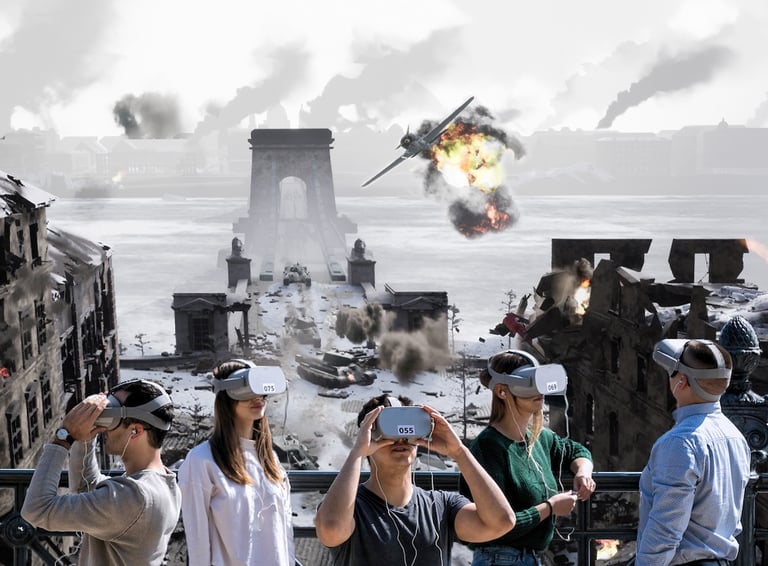
This VR project recreates key historical moments at Buda Castle in Budapest, one of Central Europe’s most significant landmarks. Designed as a 7-stop immersive walking tour, the experience allows visitors to explore the castle grounds and, at specific locations, put on a VR headset to witness dramatic events from history unfold exactly where they happened.
The challenge of this project lay in condensing centuries of history into a cohesive VR journey, while ensuring both historical accuracy and immersive storytelling across multiple distinct time periods.
The Experience
Visitors follow a guided path with seven dedicated VR stations, each bringing the past to life:
Construction of the Buda Castle (13th century) - Witness the birth of the fortress, with medieval masons, scaffolding, and stone walls rising.
Siege of Buda (1541) - The Ottoman takeover, with cannons firing and defenders holding the walls.
Siege of Buda (1686) - The bloody retaking of the castle, with smoke, fire, and intense battle scenes.
Hungarian Revolution (1848) - Crowds gather in the square, banners raised, echoing demands for freedom.
1896 Millennial Exhibition - A moment of celebration, with the castle decorated and bustling with life.
The Fall of Budapest (1945) - The Second World War’s devastation: bombings, collapsing walls, and advancing Soviet troops.
Hungarian Revolution (1956) - Street protests erupt into violent clashes, with Molotov cocktails, tanks, and the voices of freedom fighters.
Each scene was designed not only as a cinematic reconstruction but as a spatial, lived experience — allowing audiences to feel the atmosphere of each era.
Outcome for the Client
Our Role
We oversaw all aspects of production across the seven scenes:
Historical Research & Environment Design
Studied archival material, paintings, and architectural records for period accuracy. Reconstructed the castle’s changing architecture across centuries, from medieval stone fortifications to 19th-century grandeur. Created props, costumes, and set dressing based on each period’s unique cultural markers.
Cinematic Storytelling & Animation
Directed animated sequences of battles, celebrations, and protests to capture the drama of each event. Balanced crowd sizes, particle effects, and animations for both atmosphere and performance. Used camera staging and VR perspective techniques to immerse users while preserving clarity.
Lighting & Atmosphere
Developed unique lighting setups for each time period: medieval construction sites, smoky battlefields, festival days, and wartime ruins. Applied weather, fire, and destruction effects for realism and emotional impact.
Technical Details
Engine: Unreal Engine
Lighting: Dynamic time-of-day & atmospheric effects tailored per scene
Crowd & Battle Simulation: Optimized crowd variation + destruction effects
Assets: Modular historical architecture, PBR materials, authentic clothing & props
Output: 3D stereoscopic videos with 8192x8192 resolution

The finished project delivers an educational and engaging cultural tourism product that:
Provides visitors with an immersive historical journey, enhancing their connection to the site.
Offers museums and tourism boards a compelling storytelling tool that blends physical exploration with virtual time travel.
Balances authenticity, drama, and accessibility, ensuring both scholars and casual visitors can engage with history.
For the client, this tour became a highlight attraction — transforming the castle visit from a static monument walk into a memorable, narrative-driven experience.
Conclusion
The Buda Castle VR Walking Tour demonstrates the potential of VR to turn cultural landmarks into living, evolving stories. By spanning over 700 years of history across seven pivotal moments, the project provides both an educational tool and an immersive attraction that bridges heritage, technology, and storytelling.